 ultimate_guide
How to Transition From Employee to Entrepreneur
Table of Contents
- The Employee to Entrepreneur Mindset Shift
- Financial Planning for Entrepreneurs: Building Your Runway
- Starting a Business While Working Full Time
- Validating Your Business Idea Before the Leap
- Legal and Tax Transition Checklist
- Exit Strategy From Employment and Professional Transition
- Employee to Entrepreneur Success Stories: Real-World Examples
- Building Your Support System and Accountability Network
Last Updated: July 26, 2026
The Employee to Entrepreneur Mindset Shift
Transitioning from employee to entrepreneur requires a fundamental rewiring of how you think about work, risk, and your capabilities. Those who succeed have simply shifted their mental framework before changing their job status. The transition isn't a single moment but a series of mindset changes that begin long before you resign.
Moving From Security to Risk Tolerance
The biggest psychological barrier isn't fear of failure, it's the loss of the paycheck. Employees trade autonomy for certainty; entrepreneurs do the opposite. Risk tolerance is a muscle you build by taking small, calculated risks while still employed. A side hustle serves this purpose perfectly, testing your business idea on nights and weekends while proving you can recover from mistakes.
The real shift happens when you stop viewing your job as your primary identity. An employee's confidence comes from their title and paycheck. An entrepreneur's confidence comes from their ability to solve problems and create value. This mental reorientation, from "I am a [job title]" to "I am someone who builds things", is where the mindset shift truly lives.
Building an Authority Mindset
Authority isn't inherited from a company or job title, it's built by consistently demonstrating expertise and delivering results. Document the clients who respect you, the colleagues who seek your input, and the problems you've solved. Write about them. Share your perspective publicly.
The authority mindset also means accepting that you won't know everything. Entrepreneurs know that learning, asking questions, and adapting are signs of strength, not weakness. This paradox, becoming more confident while becoming more willing to admit what you don't know, separates entrepreneurs from employees pretending to be entrepreneurs.
Financial Planning for Entrepreneurs: Building Your Runway
The most common reason entrepreneurs fail isn't that their business idea is bad, it's that they run out of money before reaching profitability. Financial planning is the difference between a venture that survives its critical early phase and one that collapses under pressure.
Calculating Your Financial Runway
Your financial runway is the number of months you can survive without business income. Calculate it by dividing your total liquid savings by your monthly burn rate, the amount you spend each month on personal expenses and basic business costs.
Track your actual spending for three months before calculating. Include rent or mortgage, insurance, food, transportation, taxes, and business expenses. Once you have your runway number, be honest about it. If you have six months of runway and your business typically takes six months to generate revenue, you now know you need either more savings, a part-time job, or a faster path to revenue.
| Financial Milestone | Timeline | Action |
|---|---|---|
| Calculate monthly burn rate | Week 1 | Track actual spending for 3 months |
| Determine runway length | Week 2 | Divide savings by monthly burn rate |
| Identify revenue targets | Week 3 | Work backward from runway to break-even |
| Build financial buffer | Ongoing | Add 2-3 months beyond minimum runway |
Cash Flow Management and Bootstrapping Strategies
Cash flow and profitability are different things. You can be profitable on paper and still run out of cash. Bootstrapping, building your business without external funding, forces you to think about cash flow from day one and often leads to smarter business decisions.
The bootstrapping mindset means getting creative about minimizing expenses without sacrificing quality. You start with the simplest version of your product or service, personally serving early customers and learning the business from the ground up. Cash flow management means understanding your payment cycles. If you invoice customers and they pay in 30 days, you need enough cash to cover expenses during that month.
Starting a Business While Working Full Time
The transition doesn't have to happen overnight. For most people, it shouldn't. Starting your business while keeping your job removes the existential pressure that clouds judgment and forces you to validate your idea under real conditions.
The Side Hustle Phase: Testing Your Idea
A side hustle is a business you build on nights and weekends while maintaining full-time employment. It validates your business idea, builds your financial runway, develops your entrepreneurial skills, and proves you can execute. The side hustle phase typically lasts 6-18 months, depending on your business model and how quickly you reach meaningful revenue.
Many entrepreneurs discover during this phase that their original idea needs adjustment. Maybe the market is smaller than expected. Maybe customers want something slightly different. These discoveries are invaluable and far less costly when you're still employed.
Time Management and Burnout Prevention
Working full time while building a business is exhausting. Time management during the side hustle phase isn't about squeezing more hours out of your day, it's about protecting the hours you do have and using them with extreme intentionality.
Set a specific number of hours per week for your side business, perhaps 10-15 hours, and protect that time like it's a client meeting. Burnout prevention also means maintaining your health and relationships. The people who successfully transition aren't the ones who sacrifice everything, they're the ones who recognize that health, sleep, and relationships are prerequisites for sustained high performance.
Validating Your Business Idea Before the Leap
An unvalidated business idea is a bet, not a plan. Validation means you've tested your core assumptions with real customers and confirmed that people will actually pay for what you're offering.
Market Research and Value Proposition Testing
Market research doesn't require a huge budget. It requires talking to potential customers and listening carefully to what they actually need. Identify your target customer with specificity. Not "small business owners," but "e-commerce store owners with 2-5 employees struggling with customer retention."
Talk to them in research conversations, not sales conversations. Ask about their current challenges, how they're solving them now, and what they'd be willing to pay for a better solution. Your value proposition is the specific problem you solve and why you solve it better than alternatives. Test it by describing it to potential customers and observing their reaction.
Building Scalability Into Your Model
Scalability means your business can grow revenue without proportionally growing your costs. If you're trading hours for money, you work more, you earn more, you have a job, not a business.
Think about your business model early. Can you eventually hire someone else to do the work? Can you create systems that reduce the time required per customer? The most successful entrepreneurs design for scalability from the beginning, even if they're not immediately pursuing it.
Legal and Tax Transition Checklist
The legal and tax aspects of transitioning from employee to entrepreneur are critical. Mistakes here can cost thousands of dollars and create serious problems.
Entity Formation and Self-Employment Obligations
Before launching your business, decide on your business structure. For solo entrepreneurs, the most common options are sole proprietorship, LLC, and S-Corp. Each has different tax implications and liability protections.
An LLC provides liability protection while maintaining tax simplicity. For most solo entrepreneurs, an LLC is the practical choice. Register your business with your state (typically $50-300) and get an EIN from the IRS (free, 15 minutes online). Self-employment taxes are the biggest surprise for new entrepreneurs. As a self-employed person, you pay both halves of Social Security and Medicare taxes, approximately 15.3% of your net income. Budget for this.
| Legal Task | Timeline | Cost | Why It Matters |
|---|---|---|---|
| Choose business structure | Before launch | Free | Determines liability and tax treatment |
| Register business | Before launch | $50-300 | Makes your business legal |
| Get EIN | Before launch | Free | Required for hiring, banking, taxes |
| Set up business accounting | Month 1 | $0-500 | Separates business and personal finances |
| Understand tax obligations | Month 1 | Free | Prevents costly mistakes |
Health Insurance and Benefits Planning
Health insurance is one of the biggest anxieties for people transitioning from employee to entrepreneur. For most people, ACA marketplace plans are the most straightforward option.
Beyond health insurance, consider disability insurance and life insurance if anyone depends on your income. Retirement planning changes when you're self-employed. You can contribute to a SEP-IRA (up to 25% of net income, with a $69,000 limit in 2026) or a Solo 401(k) (up to $69,000 in 2026). Starting early matters, retirement savings compound over decades.
Exit Strategy From Employment and Professional Transition
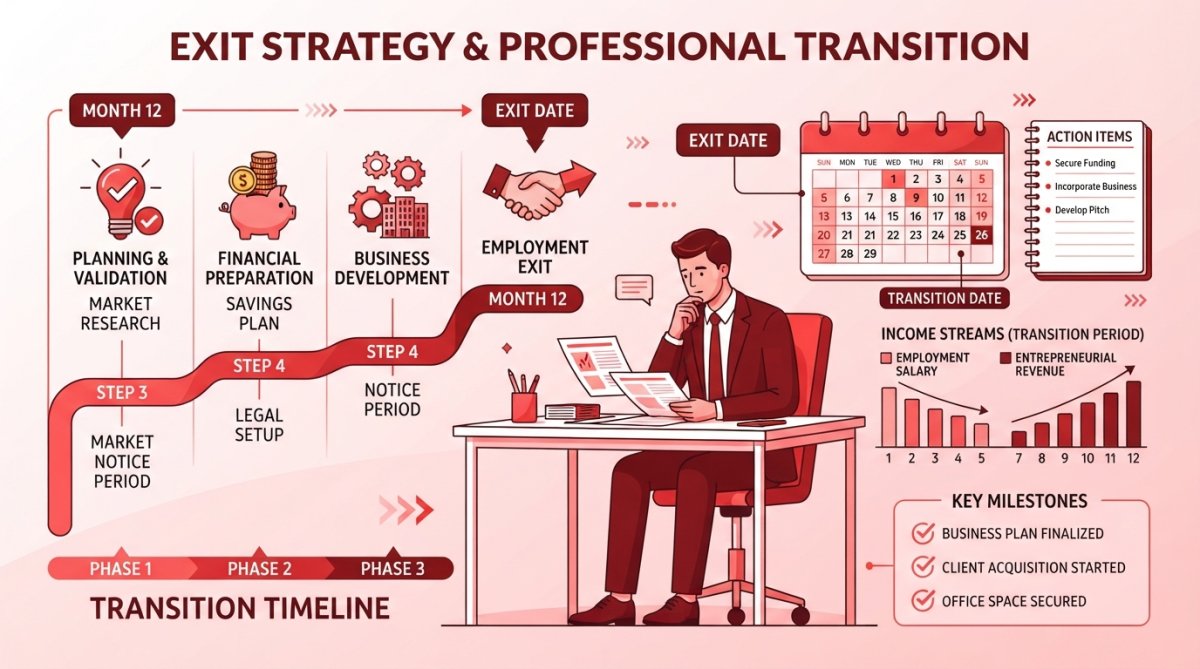
The decision to leave your job isn't made on the day you resign. It's made months in advance through careful planning. A poor exit can damage relationships, create legal complications, and leave you without critical references.
Timing Your Departure and Non-Compete Considerations
The best time to leave your job is when your business generates enough revenue to cover your expenses and you have 6-12 months of runway in savings. Check your employment contract for non-compete clauses. These agreements restrict where you can work or what business you can start after leaving. Understand what you're bound by before you resign.
Timing also matters for vesting and bonuses. If you're close to vesting in stock options or earning a bonus, understand when you'll actually receive those benefits. Give appropriate notice and use that time to document your work, train your replacement, and leave things in good order. The professional relationships you maintain matter more than you might think.
Maintaining Your Professional Network
Your professional network is one of your most valuable assets in the transition. The relationships you've built over years of employment become customers, partners, and references. Before you leave, identify the people who've been important to your career and reach out personally.
Don't immediately pitch your business to everyone. Instead, stay genuinely connected. Share relevant articles, congratulate people on promotions, ask for advice on challenges you're facing. The business relationships grow naturally from authentic connection. Some of your best early customers will come from your existing network because they know your work quality and trust you.
Building Your Support System and Accountability Network
The transition from employee to entrepreneur is not a solo journey. The entrepreneurs who succeed build support systems that keep them accountable, provide perspective, and offer both practical help and emotional support.
Mentorship, Peer Groups, and Professional Development
A mentor is someone who's already made the transition and can guide you through specific challenges. Peer groups, other entrepreneurs at a similar stage, provide something mentors can't: people who are in the trenches with you right now.
Professional development doesn't stop when you become an entrepreneur. It changes. You're no longer developing skills for your employer but for your business. At Business Success Training Institute, entrepreneurs access structured guidance through over 180 lesson plans and videos covering everything from business model development to financial management to leadership. The combination of self-paced learning and live group video sessions creates accountability while respecting the flexibility entrepreneurs need.
The transition from employee to entrepreneur is one of the most significant decisions you'll make. It requires mindset shifts, financial planning, and careful execution. The key is to treat this as a process that unfolds over months. Build your business while employed. Validate your idea with real customers. Develop your financial runway. Prepare yourself mentally and legally. Then, when the conditions are right, make the transition with confidence and clarity.
Business Success Training Institute helps entrepreneurs navigate this exact transition through structured guidance, peer support, and expert consultation. Whether you need help validating your business idea, understanding your financial runway, or building the accountability systems that keep you on track, the right support system makes the difference between a transition that succeeds and one that struggles.
Frequently Asked Questions
What is the hardest part about transitioning from employee to entrepreneur?
The hardest part is managing the psychological and financial shift simultaneously. Most people struggle with loss of stable income, benefits, and the identity tied to their job title. The fear of failure and uncertainty can trigger burnout, especially during the dual-career phase when you're maintaining employment while building your business. Overcoming this requires a clear financial runway (typically 6-12 months of expenses saved), a validated business idea, and a strong support network for accountability and mentorship.
How do I shift my mindset from employee to entrepreneur?
The mindset shift involves moving from security-seeking to calculated risk tolerance, and from task execution to strategic ownership. Start by building an authority mindset, position yourself as an expert in your field through personal branding and digital presence. Run a side hustle while employed to test your entrepreneurial resilience. Focus on scalability and business model thinking rather than just selling your time. This transition typically takes 3-6 months of intentional practice before you're psychologically ready to leave employment.
Should I quit my job before starting a business?
No, most successful entrepreneurs recommend starting a side hustle while still employed. This allows you to validate your business idea, build initial cash flow, and test your time management capacity without risking financial stability. Only quit when your business generates consistent revenue (ideally 50-75% of your current salary) and you have 6-12 months of personal expenses saved. An exit strategy from employment should be planned, not impulsive. Consider non-compete agreements and benefits planning before you resign.
How do I financially prepare to become an entrepreneur?
Financial planning for entrepreneurs requires three key steps: (1) Calculate your financial runway, how many months you can survive on savings if your business generates zero revenue; (2) Build a bootstrapping strategy using passive income or side hustle revenue to fund growth; (3) Plan for cash flow management, including tax obligations and health insurance costs. Most experts recommend saving 6-12 months of living expenses before transitioning full-time. Track your personal burn rate and business model scalability before committing to self-employment.
What legal and tax steps do I need to take when transitioning to entrepreneurship?
Key steps include: (1) Choose an entity structure (sole proprietorship, LLC, S-Corp, or C-Corp) based on your business model and tax situation; (2) Register your business with your state; (3) Obtain an EIN (Employer Identification Number) from the IRS; (4) Understand self-employment tax obligations (15.3% combined rate); (5) Plan quarterly estimated tax payments; (6) Secure health insurance (marketplace, spouse's plan, or professional association coverage); (7) Review any non-compete agreements in your employment contract. Consult a CPA and business attorney to ensure compliance.
How can I prevent burnout while running a side hustle and working full time?
Burnout prevention during the dual-career phase requires strict time management and realistic expectations. Set clear boundaries: allocate 10-15 hours per week to your side hustle, not 30+. Focus on high-impact activities (market research, customer validation, product development) rather than busywork. Build accountability through mentorship or peer groups to maintain resilience. Track your energy levels weekly. Remember that this phase is temporary, it's a testing ground, not permanent. If you're experiencing chronic fatigue, scale back and extend your timeline rather than burning out completely.
How do I know if my business idea is validated enough to leave my job?
Validation requires evidence, not just enthusiasm. You need: (1) At least 20-30 paying customers or pre-orders; (2) Consistent monthly revenue for 3+ months; (3) Clear understanding of your value proposition and target market; (4) Proof that your business model is scalable; (5) Customer feedback showing strong product-market fit. Run market research surveys, conduct customer interviews, and test your pricing. A validated business idea generates revenue and repeatable customer acquisition, not just interest. Use your side hustle phase to gather this proof before making your entrepreneurial journey full-time.
This article was written using GrandRanker