 listicle
Small Business Growth Strategies for 2026
Table of Contents
- 1. Build a Data-Driven Sales Playbook
- 2. How to Improve Business Profit Margins Through Operational Efficiency
- 3. Implement AI and Automation for Scalable Operations
- 4. Customer Retention Strategies for Small Business Growth
- 5. Small Business Scaling Tools and Tech Stack Integration
- 6. Develop Financial Resilience and Cash Flow Management
- 7. Create an Agile Culture to Support Small Business Growth Strategies
Last Updated: August 17, 2026
Small Business Growth Strategies for 2026
The difference between a stalled business and one that scales is strategy. If your company's revenue has plateaued, profit margins are shrinking, or you're struggling with operational demands, the problem usually traces back to one thing: you're still running your business like it's smaller than it actually is. Small business growth strategies for 2026 require a fundamental shift in how you approach sales, operations, customer relationships, and financial planning. The businesses that scale aren't necessarily the ones with the best products, they're the ones with systems.
This guide covers seven proven small business growth strategies that address the real constraints most owners face: generating consistent revenue, improving margins, keeping customers coming back, and building a team culture that supports growth.
1. Build a Data-Driven Sales Playbook
A sales playbook is your competitive edge. It's the documented process that turns leads into customers consistently, without depending on one charismatic salesperson who might leave tomorrow.

Your playbook should answer three questions: Who are we targeting? What's our approach? How do we measure success? Start by mapping your customer journey. Identify where prospects enter your funnel, what moves them forward, and where they typically stall.
Create a simple spreadsheet tracking deal size, time to close, who closed it, what objections came up, and how they were handled. After 30-50 deals, patterns emerge. You'll see which salespeople close fastest, which objections are deal-killers, and which customer types have the highest lifetime value.
Document your best closer's actual process: what discovery questions they ask, what objections they anticipate, and their follow-up cadence. This is the difference between a business that scales and one that maxes out when you do.
2. How to Improve Business Profit Margins Through Operational Efficiency
Profit margins improve by eliminating waste. Most small business owners don't realize how much money leaks through inefficient processes: duplicate work, unused tools, unnecessary meetings, and slow approval chains.
Spend a week documenting how work actually flows through your business. Where does time get wasted? Where do things get done twice? You'll likely find that 20-30% of your operational cost is pure waste.
Common efficiency kills include manual data entry across multiple systems, approval processes requiring too many people, and tools that don't talk to each other. The path forward is integration. Tools like HubSpot CRM, Zoho CRM, and Salesforce Starter Suite eliminate manual handoffs by centralizing customer data. When your sales, service, and accounting teams access the same customer record, you cut administrative overhead dramatically. QuickBooks automates expense tracking and tax preparation.
Automation also improves accuracy, which protects margins. Fewer data-entry errors mean fewer refunds and chargebacks.
3. Implement AI and Automation for Scalable Operations
AI and automation are no longer optional for small businesses competing in 2026. Start with the highest-impact areas: customer support and lead qualification. A tool like Tidio combines live chat with an AI chatbot that answers common questions automatically. Your team handles complex issues; the AI handles FAQs.
For lead qualification and follow-up, set up workflows that trigger emails based on behavior, when someone visits your pricing page, opens your email, or downloads a resource. These automated sequences keep prospects engaged without consuming your team's time. Klaviyo and ActiveCampaign excel at this for e-commerce; HubSpot does it well across all industries.
For content and marketing, AI writing assistants like Jasper help you create on-brand content at scale. Your team edits and refines, but the heavy lifting is automated.
The key insight: automation replaces repetitive decisions, not humans. Every time your team does something the same way twice, it's a candidate for automation. Automating just five routine tasks can free up thousands of hours annually.
4. Customer Retention Strategies for Small Business Growth
Acquiring a new customer costs 5-25 times more than keeping an existing one. Yet most small businesses obsess over acquisition and neglect retention.
Customer retention starts with understanding why customers leave. Customers rarely leave because of price, they leave because they feel forgotten, support is slow, or they don't see ongoing value.
First, create a retention metric: how many of your customers are still buying after 12 months? If it's below 70%, retention is your biggest growth lever. Track it monthly.
Second, implement a feedback loop. After a customer makes a purchase, reach out and ask what they needed, whether you delivered, and what could improve. You'll uncover problems before customers leave.
Third, create a reason for customers to stay engaged. This could be exclusive content, early access to new products, or a loyalty program. Consistency matters more than the form.
Fourth, measure customer lifetime value by segment. Some customers are worth 10x more than others. Focus retention efforts on your high-value segments first.
5. Small Business Scaling Tools and Tech Stack Integration
Your tech stack is either enabling growth or blocking it. Most small businesses have too many tools that don't talk to each other.
Schedule a Free Initial Consultation by Video Call! →
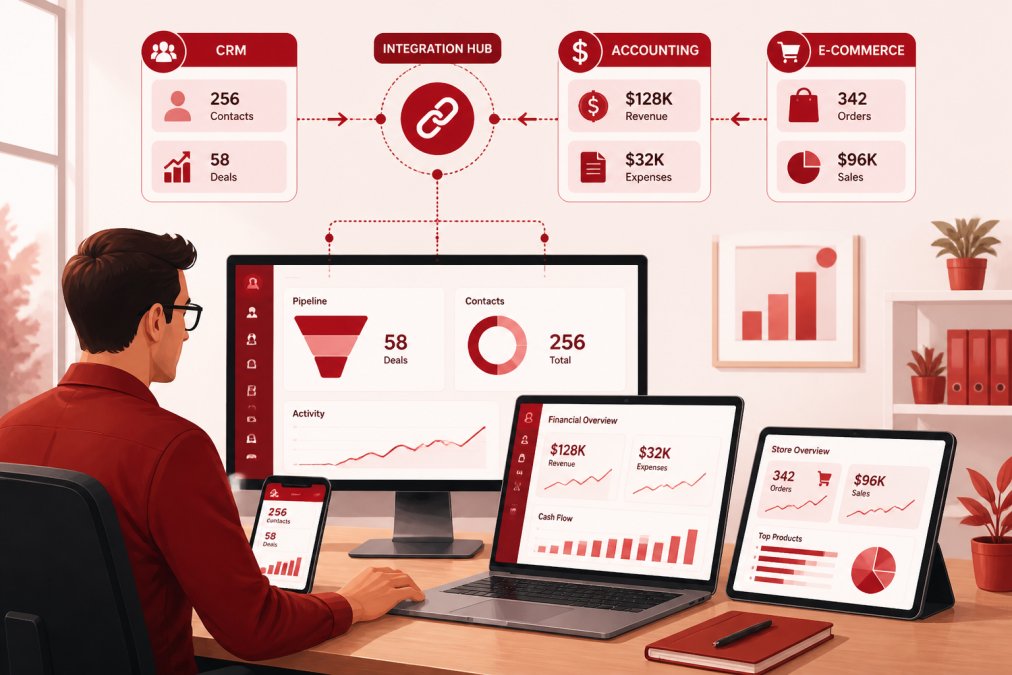
The core of your stack should be a CRM, a single source of truth for customer data. HubSpot CRM offers a free tier with genuine functionality. Zoho CRM is budget-friendly. Salesforce Starter Suite is for businesses ready to invest in enterprise-grade power. All customer interactions, sales, support, marketing, should flow through one system.
Connected to your CRM should be accounting software. QuickBooks is the industry standard for small businesses. It connects to your bank accounts, automates expense tracking, and generates financial reports.
For e-commerce businesses, Shopify handles both the storefront and payment processing. For HR and payroll, Rippling unifies hiring, onboarding, payroll, and benefits. For content and knowledge management, Notion AI helps your team organize information. For marketing automation, Klaviyo (e-commerce) and HubSpot (all industries) handle email sequences and customer segmentation.
Data should flow automatically between systems. If you're manually moving data from your CRM to your accounting software, you've missed the point. Tools like Zapier or native integrations should handle this.
| Tool Category | Top Pick | Alternative | Best For |
|---|---|---|---|
| CRM | HubSpot CRM | Zoho CRM | All-in-one customer data |
| Accounting | QuickBooks | Zoho Books | Financial tracking and reporting |
| E-commerce | Shopify | WooCommerce | Online sales and inventory |
| HR/Payroll | Rippling | Gusto | Team management and compliance |
| Marketing Automation | Klaviyo (e-comm) | ActiveCampaign | Email sequences and segmentation |
| Support Chat | Tidio | Intercom | Customer support automation |
6. Develop Financial Resilience and Cash Flow Management
Profitability and cash flow are not the same thing. A business can be profitable on paper and run out of cash. This kills more small businesses than poor products.
Financial resilience means predictable cash flow, a cash reserve, and the ability to weather disruption. Start by mapping your cash cycle. How long does it take from when you pay for inventory or labor to when you collect payment from customers? If it's 60 days, you need 60 days of operating expenses in reserve.
Implement weekly cash flow monitoring. Track your cash position every week. Know exactly how much you have, what's coming in, and what's going out.
Manage your payment terms aggressively. If you're paying suppliers in 30 days but collecting from customers in 60 days, you're financing your customers' operations. Negotiate longer payment terms with suppliers and shorter terms with customers.
Reduce unnecessary inventory and overhead. Every dollar tied up in inventory is a dollar you can't use for growth or emergencies. Review your subscriptions, licenses, and contracts quarterly.
Finally, build a cash reserve. Aim for three months of operating expenses. This is your safety net when opportunities appear or disruptions occur.
7. Create an Agile Culture to Support Small Business Growth Strategies
Culture determines whether your small business growth strategies actually work. If your team is resistant to change, automation will fail. If people are siloed, integration won't work.
Agile culture means transparency, experimentation, and accountability. Start with transparency. Share your financial metrics, growth targets, and challenges with your team. When your team understands why a decision matters, they execute better.
Second, embrace experimentation. Test new approaches on a small scale before committing fully. Give your team permission to fail.
Third, build accountability into your systems. Each person should have clear metrics tied to business outcomes. A salesperson should know their close rate and average deal size. A support person should know their resolution time and customer satisfaction score. A marketer should know their cost per lead and conversion rate.
Fourth, invest in your people. Provide training, mentorship, and career paths. Business owners who invest in employee development see their best people stay longer and perform better.
Small business growth strategies for 2026 work when you address all seven areas: how you sell, how you operate, how you use technology, how you keep customers, what tools you use, how you manage cash, and how your team works together. You don't need to do everything at once. Start with the area causing the most pain, usually sales playbook or operational efficiency, and build from there.
If you're ready to move beyond strategy to implementation, Business Success Training Institute offers structured consulting and over 180 lesson plans designed to help you execute these strategies in your specific business. Whether you're focused on improving profit margins, scaling operations, or building a stronger team, access to expert guidance and peer learning through group video sessions accelerates your progress. Schedule a free initial consultation by video call to discuss which strategies matter most for your situation.
Frequently Asked Questions
What are the most effective small business growth strategies for 2026?
The most effective small business growth strategies combine data-driven decision-making, operational automation, and customer-focused initiatives. Focus on building a documented sales playbook, implementing AI tools to reduce overhead, and strengthening customer retention through personalized engagement. Financial resilience, maintaining healthy cash flow and profit margins, underpins all growth. Pair these with an agile culture that responds quickly to market shifts and you create sustainable, scalable growth.
How can I improve business profit margins without raising prices?
Improving profit margins starts with operational efficiency. Automate repetitive tasks to reduce labor costs, negotiate better supplier terms, and eliminate unnecessary overhead. Review your customer acquisition cost against lifetime value to focus on high-margin segments. Implement systems like QuickBooks or Zoho CRM to track spending and identify waste. Many small business owners find that tightening processes, not cutting quality, recovers 5-15% margin improvement within 90 days.
Which small business scaling tools should I prioritize first?
Start with tools that address your biggest bottleneck. If customer management is chaotic, choose HubSpot CRM or Zoho CRM to centralize data. If accounting is manual and error-prone, implement QuickBooks to automate invoicing and expense tracking. For e-commerce, Shopify or Tidio handles sales and customer support. Once foundational tools are in place, add automation layers like Notion AI or Jasper for content and operations. Integration matters more than the number of tools.
How do I retain customers while scaling my business?
Customer retention requires systems, not just good intentions. Set up automated feedback loops using your CRM to track satisfaction and identify churn signals early. Personalize communication based on purchase history and preferences. Implement loyalty programs or tiered pricing that reward repeat purchases. Train your team on consistent service delivery as you hire. Many scaling businesses lose customers because service quality drops during growth, clear processes and accountability prevent this.
This article was written using GrandRanker