 listicle
Business Acquisition Alternatives: 10 Options Beyond Barnett
Table of Contents
- Why Entrepreneurs Seek David C Barnett Alternatives
- Quick Comparison: Top Business Acquisition Alternatives
- Business Acquisition Coaches: Structured Programs for Deal Success
- Online Marketplaces for Buying a Business: Self-Directed Deal Discovery
- Small Business Exit Planning Resources: Valuation and Legal Support
- Business Valuation Services for Entrepreneurs: Choosing the Right Approach
- How to Evaluate Your David C Barnett Alternative: Selection Framework
- Cost-Benefit Analysis: Group Coaching vs. Marketplace vs. Legal Support
Business Acquisition Alternatives: 10 Options Beyond Barnett
Last Updated: July 22, 2026
Many entrepreneurs exploring business acquisition discover that alternatives to David C Barnett offer different coaching styles, pricing models, and deal-sourcing strategies. The landscape has shifted considerably, entrepreneurs now have access to specialized platforms, group coaching programs, and legal support services that didn't exist five years ago. The real question isn't whether alternatives exist, but which matches your situation: Are you bootstrapping or raising capital? Do you need deal flow, or do you have targets? Do you learn better in groups or 1-on-1? This guide breaks down the 10 most credible options beyond David C Barnett.
Why Entrepreneurs Seek David C Barnett Alternatives
Entrepreneurs typically search for alternatives for three concrete reasons: pricing concerns, learning style preference, or geographic limitations. Some want group coaching at lower cost. Others prefer marketplace-based deal discovery over broker networks. Still others need specialized legal support or valuation expertise that general acquisition coaches don't provide.
According to Babson College's entrepreneurship research, interest in small business acquisition as an alternative to startups has grown consistently. Business Success Training Institute has observed that entrepreneurs often combine multiple resources rather than betting on a single coach or platform, using an online marketplace for deal discovery, a group coaching program for structure, and a flat-fee legal firm for due diligence.
Quick Comparison: Top Business Acquisition Alternatives
| Alternative | Best For | Starting Price | Key Advantage |
|---|---|---|---|
| Acquira | Structured 8-12 month programs | Contact for pricing | MBA-level playbook for deal sourcing |
| SMBootcamp | Community-driven learning | Contact for pricing | Practical ETA training with peer support |
| MentorCruise | Personalized 1-on-1 guidance | Free trial, then varies | Industry experts from major tech companies |
| BizBuySell | Self-directed marketplace browsing | Free for buyers | Largest U.S. business listing inventory |
| BizQuest | Cross-listed opportunities | Free for buyers | Broker network integration and financing help |
| Flippa | Digital asset acquisitions | Free for buyers | Specialized platform for online businesses |
| BizEquity | Industry-specific valuations | Contact for pricing | Database of millions for comparative analysis |
| Valutico | Multi-methodology valuations | Contact for pricing | 15+ valuation approaches in one tool |
| Surge Business Law | Deal legal support | 0.85% of transaction value | Flat-fee pricing eliminates hourly billing surprises |
| Business Success Training Institute | Comprehensive business training | Varies | 180+ lesson plans plus live group coaching |

Business Acquisition Coaches: Structured Programs for Deal Success
Group coaching programs have become the dominant model for entrepreneurs serious about small business acquisition. Unlike generic consulting, acquisition-focused coaches walk you through deal sourcing, due diligence, financing, and integration over 8-12 months. The trade-off is real: group programs sacrifice personalization for affordability and peer learning. You're in cohorts with 10-50 others, but you gain accountability partners, deal feedback, and a network of people on the same journey.
Acquira: MBA-Level Playbook for Small Business Buyers
Acquira positions itself as the "MBA for acquisition" with a comprehensive 8-12 month program covering deal sourcing through integration. They focus on the retiring business owner wave, teaching you how to position yourself as a buyer and structure deals that work for both sides. The program requires 15-20 hours per week and includes a playbook, mentorship, and financing resources, particularly SBA loans.
SMBootcamp: Entrepreneurship Through Acquisition Community
SMBootcamp is built for people learning Entrepreneurship Through Acquisition (ETA) without traditional business backgrounds. The emphasis is practical: sourcing deals, evaluating them, financing them, and scaling. The bootcamp format is intense with immersive training, group projects, and real deal analysis. This works well if you're self-directed; it's less ideal if you prefer self-paced learning.
MentorCruise: 1-on-1 Acquisition Expert Mentoring
MentorCruise connects you with personalized 1-on-1 mentoring from industry experts at companies like Amazon and Airbnb. The appeal is obvious: guidance tailored to your specific situation. The catch is cost variability and mentor-fit dependency. Success depends entirely on chemistry between mentor and mentee.
Online Marketplaces for Buying a Business: Self-Directed Deal Discovery
Marketplaces are platforms where business owners list companies for sale. The advantage is control and cost, you're not paying for coaching you might not need. The disadvantage is you're on your own. Most entrepreneurs use marketplaces in combination with other resources: browse listings, then bring promising deals to your coach or lawyer for evaluation.
BizBuySell: The Largest U.S. Business Marketplace
BizBuySell has facilitated over 100,000 successful sales across every industry. Filter by industry, location, price, and revenue. The sheer volume means higher probability of finding something interesting, but also requires sorting through mediocre deals. Many listings lack detailed financial data, forcing you to request information before proper evaluation.
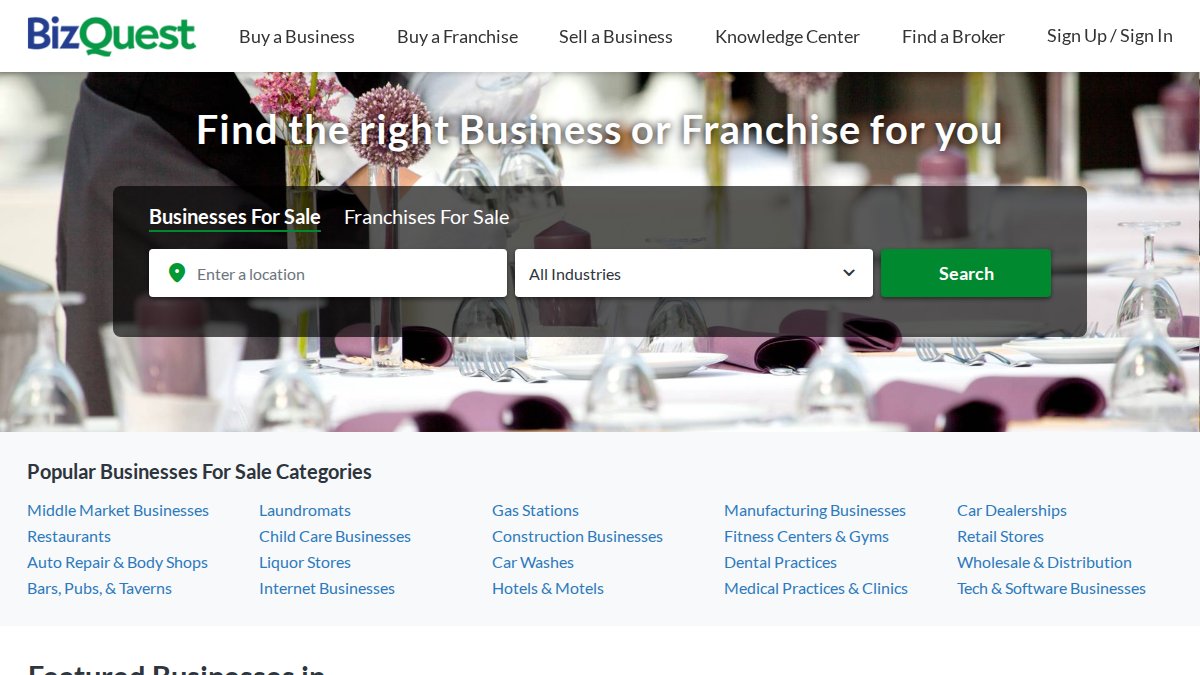
BizQuest: Cross-Listed Opportunities with Broker Network
BizQuest operates similarly to BizBuySell but listings are often cross-posted with BizBuySell and LoopNet, amplifying exposure. Backed by CoStar Group, it explicitly connects buyers with financing solutions. Like BizBuySell, deal quality varies, but the broker network integration is valuable.
Flippa: Specialized Platform for Digital Asset Acquisitions
Flippa is the marketplace for online businesses, websites, and digital assets. If you're buying an e-commerce store, SaaS business, or affiliate site, Flippa has deal flow from over 300,000 exits. The platform understands digital metrics, traffic, revenue, profit margins, customer acquisition cost, in ways general marketplaces don't. The disadvantage is specialization: Flippa only covers digital assets, not local service businesses or restaurants.

Small Business Exit Planning Resources: Valuation and Legal Support
Valuation and legal support are essential but unglamorous parts of acquisition. You can't make a smart offer without knowing what a business is worth, and you can't close without legal documents that protect you.
BizEquity: Industry-Specific Business Valuations
BizEquity provides online business valuations based on industry-specific metrics and a database of millions of comparable businesses. You input financial data and get estimated value using multiple methodologies in minutes. The limitation is that BizEquity is an estimation tool, not a professional appraisal. It's useful for initial screening but serious deals require professional appraisal.
Valutico: Multi-Methodology Valuation Platform
Valutico offers 15+ valuation methodologies, showing you how different approaches value the same business. This reveals the range of reasonable valuations rather than a single number. The multiple methodologies approach is particularly useful for unusual businesses or non-standard financials. Like BizEquity, it's a starting point, not a substitute for professional appraisal.
Surge Business Law: Flat-Fee Legal Support for Buyers
Surge Business Law specializes in legal support for business buyers, handling due diligence review, purchase agreements, letters of intent, and negotiation guidance. The key differentiator is flat-fee pricing: 0.85% of transaction value with a $1,800 minimum. This eliminates unpredictability of hourly legal billing. Surge focuses on getting deal structure right before signing, providing clear guidance on risk and terms. The limitation is scope, they handle documentation but not ongoing legal support, tax structuring, or post-close disputes.
Business Valuation Services for Entrepreneurs: Choosing the Right Approach
Valuation is not one-size-fits-all. Different methodologies produce different results.
Asset-based valuation estimates value based on tangible assets: equipment, inventory, real estate. This works for asset-heavy businesses like manufacturing but poorly for service businesses.
Income-based valuation estimates value based on profit generation ability, using multiples like EBITDA. A business earning $100K in EBITDA might be valued at 3-5x that amount, depending on industry and growth.
Market-based valuation estimates value based on comparable business sales. This requires transaction data access but grounds valuation in real market behavior.
For most small business acquisitions, use a combination of these approaches: marketplace valuation tools provide a starting point, industry-specific multiples apply context, and comparable sales confirm the range.
How to Evaluate Your David C Barnett Alternative: Selection Framework
Choosing between alternatives requires clarity on what you actually need. Are you shopping for coaching, deal flow, legal support, or a combination?
Start with your timeline. If you need to close in 12 months, a structured program might be overkill. A marketplace plus legal support might be faster. If you have 18+ months, a full coaching program makes sense.
Assess your capital situation. Do you have cash on hand or need financing help? If you need SBA loans, Acquira's financing focus is valuable. If self-funded, a marketplace plus flat-fee lawyer is cheaper.
Evaluate your learning style. Do you learn better in groups or 1-on-1? Are you self-directed or need external structure? Group programs provide structure. Marketplaces require self-direction. MentorCruise offers personalized guidance.
Consider your industry focus. Digital assets favor Flippa. Local service businesses favor BizBuySell or BizQuest. Unusual businesses might need multiple sources.
Define your budget. Coaching programs typically require $5K-$15K+. Marketplaces are free to browse. Legal support and valuation services are transaction-based. Business Success Training Institute offers flexible options starting with individual lesson plans, scaling to full consulting.
| Decision Factor | Coaching Program | Marketplace | 1-on-1 Mentoring | Legal Support |
|---|---|---|---|---|
| Best for timeline | 12-18 months | 6-12 months | Flexible | 3-6 months |
| Requires capital? | Yes ($5K-15K+) | No | Yes (varies) | Yes ($1,800+) |
| Learning style | Group/structured | Self-directed | Personalized | N/A |
| Deal sourcing | Included | Marketplace | Mentor guidance | No |
| Legal guidance | Limited | No | Possible | Yes |
Cost-Benefit Analysis: Group Coaching vs. Marketplace vs. Legal Support
Group coaching program: $5K-$15K+ investment. You get structured learning, peer feedback, and accountability. This makes sense if you're new to acquisition and value structure.
Marketplace plus legal support: $0 to browse, plus $1,800+ in legal fees when you find a deal. You get unlimited deal flow and professional legal review. This makes sense if you know what you're looking for and are comfortable with self-analysis.
1-on-1 mentoring: Typically $500-$2,000+ per month. You get personalized guidance for your specific situation. This makes sense for specific deals requiring expert feedback.
Valuation services: $300-$1,000+ depending on complexity. You get estimated business value. This makes sense as a screening tool.
Many successful acquirers use a hybrid approach: browse marketplaces (free), use valuation tools to screen ($500-$1,000), engage legal for serious deals ($1,800+), and optionally join group coaching ($5K-$15K+). Total investment: $7,300-$17,500+. The question isn't which option is cheapest, but which combination delivers outcomes you need at justifiable cost.
Choosing a business acquisition path means matching your learning style, timeline, and capital to the right resources. Whether exploring group coaching, marketplace deal flow, legal support, or combinations, be intentional. Business Success Training Institute provides comprehensive training through 180+ lesson plans and live group coaching, helping entrepreneurs navigate acquisition decisions with expert guidance. Start with a free initial consultation to discuss your specific situation and determine which resources align with your acquisition goals.
Frequently Asked Questions
What are the main differences between business acquisition coaches and online marketplaces?
Acquisition coaches like Acquira and SMBootcamp provide structured training, mentorship, and guidance through the entire buying process, ideal if you want expert support navigating due diligence and financing. Online marketplaces like BizBuySell and BizQuest are self-directed deal-discovery platforms where you browse listings independently. Coaches offer community and accountability; marketplaces offer speed and autonomy. Your choice depends on whether you need hands-on guidance or prefer to move at your own pace.
Are there free alternatives to David C Barnett for entrepreneurs buying a business?
Yes, several free or low-cost options exist. SCORE (score.org) and local Small Business Development Centers (SBDCs) offer free business consulting. BizBuySell and BizQuest allow free browsing of listings. MentorCruise offers free trial sessions with acquisition mentors. However, these free resources typically don't provide the comprehensive, structured curriculum or ongoing community support that paid programs offer. Free options work best if you already have strong financial and legal knowledge.
What should I look for in a business valuation service when comparing alternatives?
Look for valuation services that use industry-specific metrics (not generic formulas), offer multiple methodologies, and provide transparent pricing. BizEquity and Valutico both offer comprehensive valuations using 15+ methodologies. Ensure the service covers your industry, retail, SaaS, and manufacturing require different valuation approaches. Also consider whether you need a quick estimate or an in-depth analysis suitable for serious M&A transactions. Many services offer free trial reports.
How do I know if an acquisition alternative is right for my specific business situation?
First, define your acquisition timeline and budget. If you need expert guidance and have 8-12 months, programs like Acquira or SMBootcamp fit well. If you want to move quickly and browse deals independently, use BizBuySell or BizQuest. Second, identify your biggest gap: deal sourcing, financing knowledge, legal protection, or valuation expertise. Choose resources that address your weakest area. Finally, consider your learning style, some prefer group coaching, others prefer 1-on-1 mentoring or self-directed learning.
What's the difference between business acquisition coaches and business consultants?
Acquisition coaches specialize in the buying process, sourcing deals, due diligence, financing, and integration. They guide you through Entrepreneurship Through Acquisition (ETA). General business consultants may help with operations, strategy, or existing business challenges but lack specific M&A expertise. If you're buying a business, seek acquisition-focused coaches. If you're optimizing an existing business, a general consultant may suffice. Many entrepreneurs use both at different stages.
This article was written using GrandRanker