 listicle
Best Online Courses for Business Owners: 2026 Guide
Table of Contents
- How We Evaluated the Best Online Courses for Business Owners
- Quick Comparison Table: Top Online Courses for Business Owners
- Top Digital Marketing Courses for Business Owners
- Leadership Courses for Entrepreneurs and Growing Leaders
- Free Online Business Courses With Certificates
- Online Courses for Small Business Marketing Strategy
- Specialized Courses: Financial Management & Business Operations
- Which Course Should You Choose? Decision Framework
Last Updated: July 21, 2026

When you're starting or scaling a business, the pressure to make smart decisions about professional development is real. The best online courses for business owners translate directly into actionable strategies you can implement immediately, not theoretical frameworks that gather dust.
This guide covers the most effective options available in 2026, including free certifications from industry leaders, specialized programs for specific business challenges, and structured curricula that balance depth with practical application.
How We Evaluated the Best Online Courses for Business Owners
We assessed each program based on five core criteria: actionable frameworks you can use immediately, clear relevance to business owner challenges (hiring, scaling, cash flow, sales), evidence that people complete courses and see results, instructor credibility from practitioners who've built actual businesses, and time investment versus depth.
A focused 20-hour program that changes how you think about customer acquisition beats a 100-hour marathon covering everything superficially.
Quick Comparison Table: Top Online Courses for Business Owners
| Course | Type | Cost | Time | Best For | Key Strength |
|---|---|---|---|---|---|
| Business Success Training Institute | Consulting + Courses | Varies | Flexible | All business stages | Expert 1-on-1 guidance + 180+ lesson library |
| Google Digital Marketing & E-commerce Certificate | Certification | ~$49/month | 3-6 months | Online sellers | Industry-recognized credential |
| HubSpot Academy Digital Marketing | Free Certificate | Free | 4-8 weeks | Marketing-focused founders | Comprehensive inbound strategy |
| MOBI (My Own Business Institute) | Free Courses | Free | Self-paced | Startup founders | Covers business fundamentals broadly |
| Wharton Entrepreneurship Specialization | University Program | ~$49/month | 4-6 months | Early-stage founders | Top-tier business school content |
| MIT OpenCourseWare Entrepreneurship | Free Courses | Free | Self-paced | Technical founders | World-class curriculum |
| Udemy Finance for Entrepreneurs | One-time Purchase | $19-199 | 4-6 hours | Financial management | Practical accounting fundamentals |
| Growist: Stop Selling > Start Solving | Sales Training | Contact for pricing | 6-8 weeks | Solopreneurs, service providers | Value-driven sales methodology |
| HubSpot Academy E-commerce Marketing | Free Certificate | Free | 3-4 weeks | E-commerce operators | Specialized for online stores |
| Salesforce B2B Commerce Basics | Free Course | Free | 2-3 weeks | B2B sellers | Platform-specific B2B expertise |
Top Digital Marketing Courses for Business Owners
Digital marketing skills separate founders who scale efficiently from those who throw money at ads and hope. The best courses teach coherent strategy where each channel reinforces the others.
Google Digital Marketing & E-commerce Professional Certificate
This Coursera certificate covers the full digital marketing stack: SEO, paid search, social media advertising, email marketing, and e-commerce fundamentals. You learn from the company that owns search and YouTube, so the SEO and paid search modules carry real weight. Real-world projects let you build campaigns and analyze results.
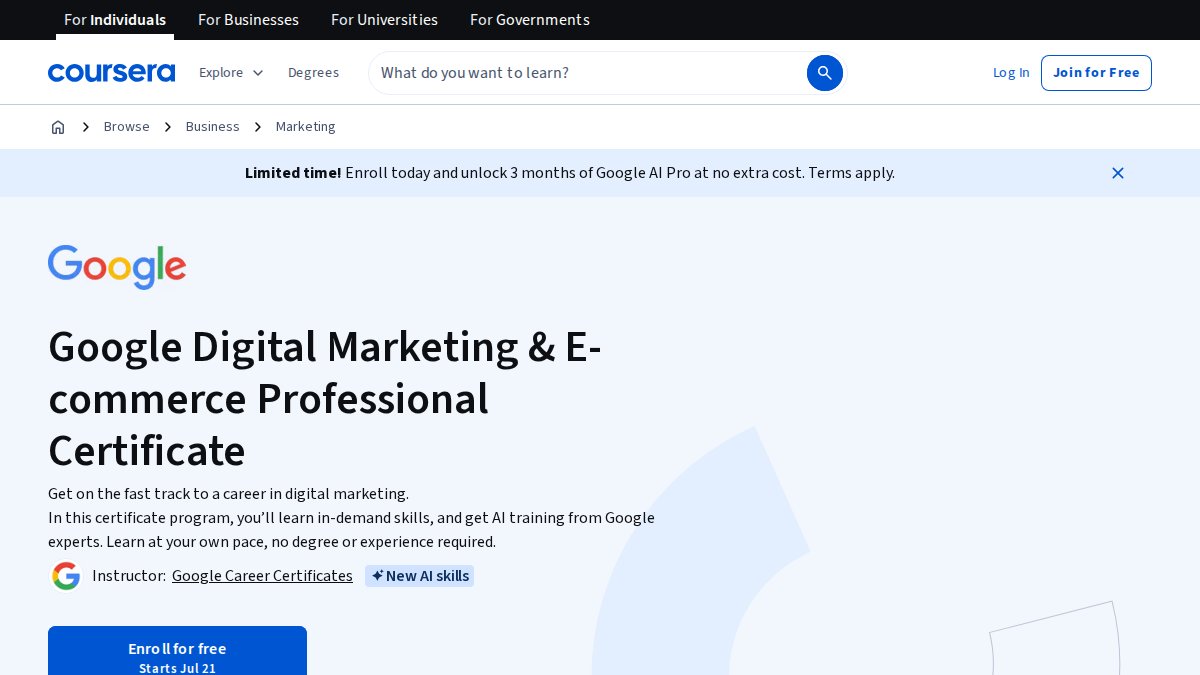
The Google credential carries weight with hiring teams and clients. If you're planning to hire a digital marketer or work with agencies, understanding their language matters.
HubSpot Academy Digital Marketing Certification
HubSpot's free certification is the most comprehensive free digital marketing course available. It covers SEO, social media, email, content marketing, and the inbound methodology HubSpot built around. The inbound philosophy (attract, engage, delight) teaches you to think about your customer's journey and what content they need at each stage.
The course is self-paced with quizzes that test comprehension. You get a real certificate upon completion.
Leadership Courses for Entrepreneurs and Growing Leaders
The gap between founding a business and leading one is vast. The best leadership courses address this directly.
Wharton Entrepreneurship Specialization
Wharton's specialization covers launching a company, validating ideas, and scaling operations. The modules on unit economics and financial modeling are particularly strong. You work through case studies of real companies and defend your own business strategy. The capstone project requires you to develop a full business plan.
This is rigorous, not feel-good leadership theory. The credential carries weight with investors and senior hires. Expect 4-6 months of 8-10 hours per week.
MIT OpenCourseWare Entrepreneurship Courses
MIT makes its entrepreneurship curriculum free through OpenCourseWare. Courses like "Entrepreneurship 101: Who is Your Customer" and "Nuts and Bolts of Business Plans" are taught by MIT faculty and practitioners. The frameworks are sophisticated and apply to any business model.
There's no instructor interaction or credential at the end, but the content is genuinely excellent for technically-minded founders.
Free Online Business Courses With Certificates
The best free courses come from institutions with credibility to protect. A free certificate from an unknown platform means nothing. A free certificate from MOBI or HubSpot signals competence.
MOBI (My Own Business Institute)
MOBI, run by Santa Clara University, offers free courses on starting and growing a business. The curriculum covers business planning, hiring, financial management, and scaling. Courses take 4-8 weeks and you get a certificate upon finishing.
MOBI is designed for people with limited business experience. The language is accessible and frameworks are practical. It's completely free with no hidden fees.
HubSpot Academy E-commerce Marketing Course
HubSpot's e-commerce marketing course is free and specifically designed for online store owners. It covers strategy, customer acquisition, conversion optimization, and retention. The modules on building effective product pages and email sequences for repeat customers are particularly strong.
E-commerce is specific enough that general digital marketing courses miss important nuances. This course gets those nuances right.
Online Courses for Small Business Marketing Strategy
Small business owners often confuse marketing tactics with strategy. Tactics are channels and campaigns. Strategy is coherent thinking about who you're reaching, why they should care, and how you're different. The best courses teach strategy first.
Growist: Stop Selling > Start Solving
Growist's program is built for solopreneurs and small business owners who hate traditional sales. Instead of pushing your solution, you diagnose the client's problem and show how you solve it. This generates better leads and higher closing rates.
The course covers positioning, lead generation, sales conversations, and closing. It's practical with real scenarios and feedback. The program runs 6-8 weeks and includes group sessions where you learn from other business owners.
Udemy Finance for Entrepreneurs & Small Businesses
This Udemy course teaches financial fundamentals without assuming accounting background. You learn to read financial statements, understand cash flow, build budgets, and make financial decisions. The instructor has consulting experience, so examples are grounded in real scenarios.

Udemy courses typically cost $19-199 with lifetime access. You get self-paced learning. Financial literacy is non-negotiable for business owners. Many founders operate with vague understanding of their numbers. This course changes that.
Specialized Courses: Financial Management & Business Operations
As your business scales, financial management and operations become critical.
Salesforce B2B Commerce Basics
If you're selling to other businesses, Salesforce's B2B Commerce Basics course on Trailhead is free and specialized. It covers setting up a B2B commerce store, managing buyer engagement, and optimizing your sales pipeline. The course also touches on how AI can improve commerce operations.
The course is short, 2-3 weeks to complete, and practical. The frameworks on buyer journey mapping and sales pipeline optimization apply to any B2B commerce operation.
Which Course Should You Choose? Decision Framework
Choosing the right course depends on your current business stage, specific skill gap, and available time.
Budget vs. Depth Trade-Offs
Free courses from HubSpot, MOBI, and MIT teach real skills without payment. The trade-off is they're general, not accounting for your specific business model. A free digital marketing course teaches digital marketing broadly, not "how to acquire customers for a B2B SaaS product with a 6-month sales cycle."
Paid courses from Coursera (Google, Wharton) cost money but deliver depth and credentials. You're paying for specialization and institutional credibility.
Business Success Training Institute sits between free and expensive. You get access to over 180 specialized lesson plans and videos covering leadership, business development, and strategic thinking. You can add live group video sessions or individual consulting, meaning you're getting feedback on your specific business, not just watching videos.
Time Commitment and Skill Level Alignment
Wharton's specialization requires 4-6 months of serious work. If you have 5-10 hours per week available, you can complete any program. If you have 2-3 hours per week, focus on shorter courses. HubSpot's digital marketing certification takes 4-8 weeks. Udemy's finance course takes a few weeks.
Consider your starting skill level. If you've never run ads, Google's certificate teaches from scratch. If you're already running ads successfully, it might feel repetitive. MOBI is designed for business beginners. Wharton assumes you understand basic business concepts.
Post-Course Implementation Support
The gap between learning and doing is where most courses fail. You can understand concepts but struggle to apply them to your actual business. The best courses provide implementation support through instructor feedback, peer groups, or ongoing resources.
HubSpot courses include community forums. Growist includes group sessions with feedback. Business Success Training Institute includes live group video sessions and individual consulting options.
Free courses typically don't include implementation support. If you're self-directed, free courses are sufficient. If you learn best through doing and getting feedback, prioritize courses with implementation support.
The Bottom Line
The best online courses for business owners are the ones you'll actually complete and apply. A prestigious course you don't finish has zero value. A free course you implement immediately has enormous value.
Start by identifying your specific skill gap. Are you weak on marketing? Take a digital marketing course. Weak on financial management? Take a finance course. Weak on leadership? Take a leadership course.
If you're new to business ownership, start with free courses from credible sources (MOBI, HubSpot, MIT). Once you've built a foundation, invest in specialized paid programs if you need deeper expertise.
The course is just input. The output, what you actually do with what you learn, is what creates value in your business.
For founders who want implementation support alongside learning, Business Success Training Institute offers access to over 180 specialized lesson plans and videos covering leadership, business development, and strategic thinking. You get live group video sessions and the option for individual consulting, meaning you're applying frameworks to your specific business with expert guidance. Schedule a free initial consultation by video call to discuss which resources match your current challenges.
Frequently Asked Questions
Are online courses for business owners actually worth the investment?
Yes, when chosen strategically. The best online courses for business owners deliver measurable ROI through improved financial management, leadership skills, and operational efficiency. However, course value depends on your specific needs and willingness to implement what you learn. Free courses like HubSpot Academy and MOBI offer excellent foundational knowledge with zero financial risk. Paid programs provide deeper specialization and often include accountability structures that accelerate results.
What's the difference between free online business courses with certificates and paid certification programs?
Free courses like HubSpot Academy and MOBI teach practical skills and award recognized certificates at no cost, ideal for foundational knowledge. Paid programs (Coursera, Wharton, Udemy) typically offer deeper specialization, structured curricula, and university-backed credentials. The trade-off: free courses require more self-direction, while paid options provide instructor support and often faster skill acquisition. Choose free courses for broad introductions; choose paid programs when you need expertise in a specific area like digital marketing or financial management.
How do I know if a business course is legitimate and not a scam?
Look for courses from accredited institutions (Wharton, MIT, Google, HubSpot), transparent pricing, real student reviews, and clearly defined learning outcomes. Legitimate courses specify what you'll learn, who teaches it, and how long it takes. Avoid courses promising unrealistic results ("triple your revenue in 30 days") or using high-pressure sales tactics. Research the instructor's background and verify credentials independently. Free trials and money-back guarantees indicate confidence in course quality.
How long does it take to see results from online business courses?
Timeline varies by course type and implementation effort. Foundational courses (digital marketing, financial basics) show results within 2-4 weeks if you apply lessons immediately. Leadership and business strategy courses typically require 6-12 weeks of practice before measurable impact. The key factor isn't course duration, it's post-course implementation support. Courses with group accountability, live coaching, or structured implementation plans accelerate results significantly compared to self-paced modules alone.
What online courses should small business owners prioritize first?
Start with courses covering your immediate business pain points. If marketing is weak, begin with digital marketing courses (HubSpot Academy, Google Certificate). If financial management is unclear, take Udemy's Finance for Entrepreneurs course. For new business owners, MOBI covers foundational business operations. For leadership gaps, Wharton's Entrepreneurship Specialization provides strategic frameworks. Most successful business owners combine one free foundational course with one paid specialization course tailored to their biggest challenge.
This article was written using GrandRanker