 listicle
7 AI Tools for Business Strategy 2026: A Practical Guide
Last Updated: October 31, 2026
Quick Summary
The right AI tools for business strategy in 2026 depend on where your plan breaks down: Cascade or WorkBoard for execution, Perplexity and ChatGPT for research, and Jasper AI or Zoho Zia for content and ecosystem needs. Build a stack of three tools that fit your workflow instead of collecting subscriptions.
- We scored tools on strategy workflow support, pricing transparency, learning curve, and small business budget fit.
- Define three to five strategic priorities before adopting an execution platform like Cascade or WorkBoard.
- Run research as a four-stage workflow ending in three strategic options, not answers.
- A forecast is only as good as its inputs, so state assumptions explicitly in three-scenario models.
- If a tool cannot show improvement on two ROI measures, it is a subscription, not a strategy asset.
Table of Contents
- Quick Comparison: AI Tools for Business Strategy in 2026
- How We Evaluated These Business Strategy Tools
- Cascade and WorkBoard: Platforms Built for Strategy Execution
- AI Tools for Market Research: Perplexity and ChatGPT
- AI Competitor Analysis Tools: Turning Public Data Into Positioning
- AI Business Forecasting Tools: Scenario Planning Without the Spreadsheet Marathon
- AI Business Plan Generator: From Blank Page to Fundable Draft
- Schedule a Free Initial Consultation to Build Your AI Strategy Stack
- Frequently Asked Questions
Quick Comparison: AI Tools for Business Strategy in 2026
The right AI tools for business strategy in 2026 depend on where your plan breaks down. If execution stalls, you need a platform like Cascade or WorkBoard. If research eats your week, Perplexity and ChatGPT carry the load.
Below, we show you exactly how to match each tool to a workflow stage, from market research to execution tracking, and where human oversight still matters most.

| Tool | Best For | Pricing | Standout Strength |
|---|---|---|---|
| Business Success Training Institute | Founders who need strategy guidance, not just software | Pricing available on the Business Success Training Institute website | 180+ lesson plans plus live consultant access |
| Cascade | Teams that plan well but execute poorly | Contact for pricing | Dedicated strategy execution focus |
| WorkBoard | Organizations formalizing OKRs | Contact for pricing | Strategy platform alternative to Cascade |
| Perplexity | Fast market and competitor research | Free plan; Pro around $20/month | Cited research answers |
| ChatGPT | General planning and analysis | Free tier; paid plans from $20/month | Flexible drafting and summarization |
| Jasper AI | Marketing teams producing content at volume | From $59/month | High-volume content marketing |
| Zoho Zia | Businesses already inside the Zoho ecosystem | Included with Zoho plans | No separate AI line item |
How We Evaluated These Business Strategy Tools
We scored each tool on four criteria: whether it supports a real strategy workflow, how transparent its pricing is, how steep the learning curve runs, and whether it fits a small business budget. A tool that drafts plans but never helps you track them earned a lower score than one built for execution.
A common mistake is buying a general-purpose assistant and expecting strategic planning to happen automatically. It won't. The tool amplifies whatever thinking you bring to it.
What most guides miss is governance. Before you paste customer data or financials into any assistant, check how the vendor handles retention and training data, and set an internal rule for what never gets uploaded. Responsible AI use is a selection criterion, not an afterthought.
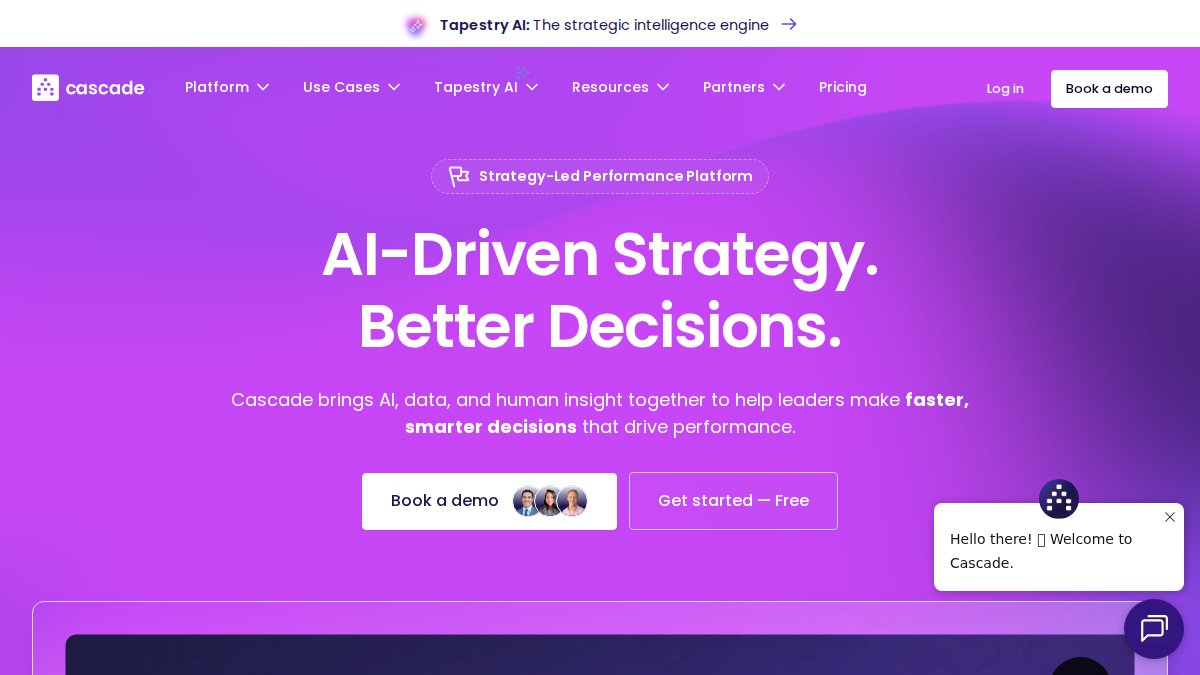
Cascade and WorkBoard: Platforms Built for Strategy Execution
Strategy execution is where most plans die, and these two platforms exist specifically to prevent that.
Neither publishes starting prices, so both require a sales conversation.
Watch out: adopting an execution platform before you have clear goals just documents the confusion. Define three to five strategic priorities first, then let the software track them.
If growth planning keeps derailing your execution, our breakdown of common mistakes in business growth planning covers the traps to clear before you buy another tool.
AI Tools for Market Research: Perplexity and ChatGPT
AI tools for market research cut the hours spent gathering competitor pages, industry reports, and customer sentiment into minutes. Perplexity answers research questions with cited sources, and ChatGPT is useful for summarizing long documents and drafting research briefs.
But naming the tools is the easy part. The strategic value comes from running a repeatable research workflow that produces evidence a planning team can act on. Here is the four-stage workflow most practitioners find works best:
- Frame the question as a decision, not a topic. Instead of "research the market," ask "should we enter the mid-market segment in 2026?" A decision-shaped prompt forces the tool to surface evidence for and against a specific move.
- Gather primary and secondary sources separately. Use Perplexity to locate public sources (competitor pricing pages, industry association reports, regulatory filings) and use ChatGPT to summarize long PDFs and transcripts you already own. Keep the two streams separate so you can trace each claim back to its origin.
- Build an evidence table, not a narrative. Ask the tool to output a table with columns for claim, source, date, and confidence. This is the single highest-leverage habit for strategy work because it exposes stale data and unsupported assertions before they reach a plan.
- Synthesize into options, not answers. Close the loop by asking the tool to list three strategic options with the evidence for and against each. The model should not pick; your team should.
The tradeoff is verification. Both tools can state outdated figures or misread a source. Treat every output as a first draft: confirm numbers against the original document before they reach a plan. For consequential decisions, keep a human reviewer in the loop and log which sources were checked. Rigorous oversight becomes even more critical when integrating specialized AI marketing consulting services into broader strategic frameworks to ensure that automated insights align with verified market realities.
Best for: early-stage research and synthesis. Skip if: you need audited financial data, which belongs in primary sources.
If research keeps stalling your planning cycle, our breakdown of common mistakes in business growth planning covers the traps to clear before you buy another tool.
AI Competitor Analysis Tools: Turning Public Data Into Positioning
AI competitor analysis tools work best when you feed them structured inputs rather than vague prompts. Pull competitor pricing pages, product descriptions, and public reviews into a document, then ask the assistant to map gaps in positioning.
A practical workflow we recommend:
Schedule a Free Initial Consultation by Video Call! →
- Collect five competitor homepages and pricing pages
- Ask the tool to summarize each one's stated audience and promise
- Request a comparison of claims, not opinions
- Verify every claim against the original page
- Write your positioning statement from the verified gaps
This keeps competitive analysis grounded in evidence rather than model guesswork.
AI Business Forecasting Tools: Scenario Planning Without the Spreadsheet Marathon
AI business forecasting tools speed up scenario planning, but they do not replace financial judgment. ChatGPT and Microsoft Copilot can build three-scenario models from your assumptions, walk through best-case, base-case, and downside revenue paths, and flag which assumptions swing the outcome most.
The discipline that matters: state your assumptions explicitly. A forecast is only as good as the inputs, and a model will happily produce confident nonsense from bad numbers. A practical structure most finance and strategy teams use is a three-scenario model with named drivers:
- Base case: current run rate, current pricing, current win rate.
- Upside case: one or two drivers improve (for example, win rate rises or churn falls).
- Downside case: the same drivers move against you, plus one external shock (a key customer loss, a price war, a supply delay).
Ask the tool to output a sensitivity table showing which driver moves the outcome most. That table, not the headline forecast, is what should drive your strategic priorities.
Measuring Strategic Impact and ROI
Most guides stop at subscription price. The more useful question for 2026 is whether the tool improves decision quality. A simple framework you can run quarterly:
- Decision speed: time from question to decision, tracked before and after adoption.
- Forecast accuracy: compare prior forecasts to actuals and track the error rate over time.
- Cost efficiency: hours of analyst or consultant time displaced, valued at your loaded hourly rate.
- Strategic outcomes: revenue, margin, or market share tied to decisions the tool informed.
If a tool cannot show improvement on at least two of these, it is a subscription, not a strategy asset. Total cost of ownership also includes setup, training, integration work, and usage limits, which often exceed the sticker price in year one.
For turning scenarios into an actual plan, our step-by-step roadmap for business expansion shows how to sequence the moves. If you are weighing aggressive growth against margin, read our guide to balancing revenue growth and profitability before you commit to a scenario.
AI Business Plan Generator: From Blank Page to Fundable Draft
An AI business plan generator produces a structured first draft fast, and that speed is genuinely useful when a blank page is the obstacle. Feed it your market research, revenue assumptions, and target customer, then edit hard.
Where these tools fall short is judgment: valuation logic, legal structure, and acquisition strategy need experienced input. That is the gap Business Success Training Institute fills. If you want to compare free drafting options first, our list of free business blueprint software picks is a sensible starting point.
Best for: founders who want a draft plus expert review. Skip if: you need a finished plan with no editing time.
Schedule a Free Initial Consultation to Build Your AI Strategy Stack
Picking tools is the easy part. The harder question is which operational skills your team needs to run them well, from process design to data hygiene. Our guide to essential business operations skills for scaling covers that groundwork.
The challenge for 2026 is not access to AI. It is choosing three tools that fit your workflow and ignoring the rest. Bring your current stack and your strategic priorities to a free initial consultation by video call, and we will map the gaps together.
Frequently Asked Questions
What are the best AI tools for business strategy in 2026?
The right pick depends on the job. Cascade and WorkBoard suit teams that need to plan and track strategy execution. Perplexity and ChatGPT handle market research and drafting. Jasper AI fits high-volume content marketing, and Zoho Zia comes included with Zoho products. For forecasting and scenario work, general assistants plus a dedicated planning platform cover most small business needs. Test one tool per function before buying several.
Can AI tools help with business forecasting and scenario planning?
Yes, within limits. AI business forecasting tools can summarize historical data, build simple projections, and draft multiple scenarios in minutes. They are useful for framing decisions, not for replacing financial judgment. Feed the tool clean numbers, ask for three scenarios (conservative, expected, aggressive), and check the assumptions yourself. Keep a human review step before any forecast informs hiring, pricing, or spending decisions.
How do small businesses use AI for strategic planning on a budget?
Start with free tiers where available, so you can run market research and draft a strategy outline before paying for anything. Pair that with a structured process: define the goal, research the market, map competitors, forecast two or three scenarios, then assign owners and deadlines. A consultant or training program can supply the framework so the tools produce usable output instead of scattered notes.
What are the risks of using AI for business decisions?
The main risks are fabricated details, outdated information, and overreliance on output nobody checked. AI assistants can state confident numbers that are wrong, so verify every statistic and citation against a primary source. Keep human oversight on pricing, legal, and hiring calls. Also review what data you paste into a tool, since customer data and financial records may be subject to privacy obligations. Treat AI output as a first draft, never a final answer.
What should businesses look for in an AI strategy tool?
Match the tool to the task. Look for a free plan or trial so you can test fit, clear pricing, and integration with the systems you already use. Check whether it supports the specific job, such as competitor analysis, forecasting, or plan drafting, rather than claiming to do everything. Confirm how it handles your data, and ask whether the team will actually use it. A cheaper tool people adopt beats an expensive platform that sits idle.
Business Success Training Institute helps founders and owners turn AI-assisted planning into execution that holds up. You get access to over 180 lesson plans and videos, weekly live group video classes, and one-on-one time with experienced consultants. Get started with Business Success Training Institute and build a strategy stack your team will actually use.